
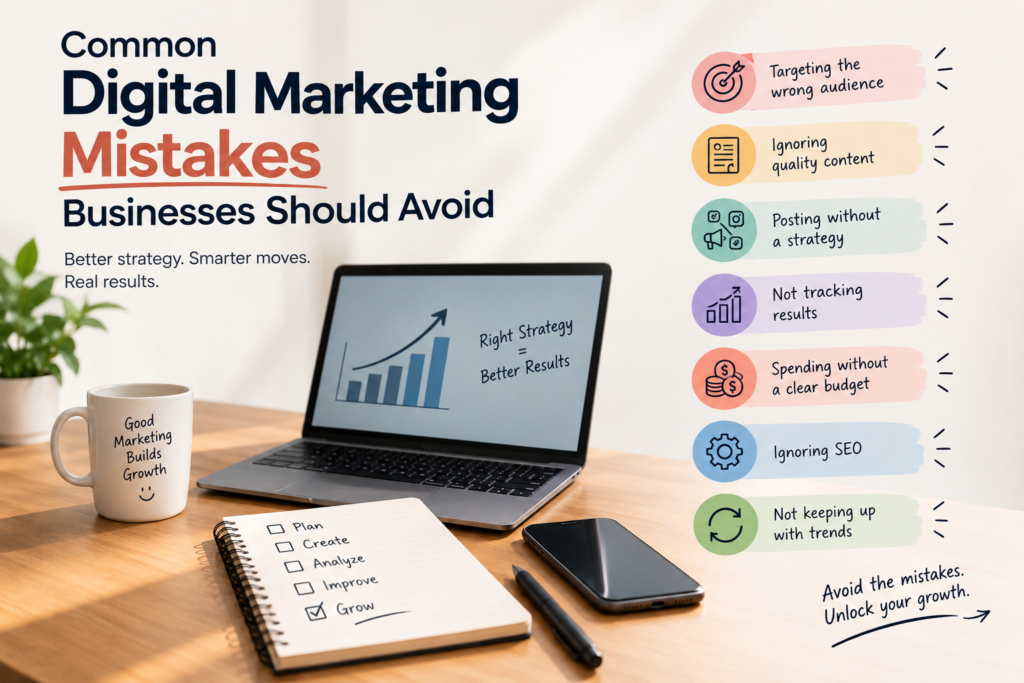
Common Digital Marketing Mistakes Businesses Should Avoid
Every business today knows it needs a digital presence — a website, maybe a few social accounts, some ads running in the background. But here’s the thing: just showing up online isn’t the same as marketing well. A lot of businesses put in real time and money and still don’t see the results they expected, usually because of a handful of mistakes that are easy to make and, thankfully, just as easy to fix once you know what to look for.
Let’s walk through the most common ones — and what to do instead.
1. Jumping In Without a Real Strategy
This is probably the biggest one. Businesses start posting on Instagram, publishing blog posts, or launching ads because “that’s what you’re supposed to do,” without ever pinning down what they’re actually trying to achieve. And when there’s no clear goal, there’s no clear way to know if any of it is working.
Before you do anything else, get specific about what you want:
- More brand awareness
- More leads
- More website traffic
- More enquiries
- More sales
- Stronger relationships with existing customers
Then figure out who you’re actually trying to reach, and pick a few KPIs you’ll actually track. A strategy doesn’t need to be complicated — it just needs to exist.
2. Treating SEO as an Afterthought
If people can’t find you when they search, none of your other marketing matters much. And yet SEO is one of the first things businesses skip or half-heartedly bolt on at the end.
The usual culprits:
- Stuffing keywords in unnaturally
- Writing for search engines instead of the people actually searching
- A confusing website structure
- Titles and meta descriptions that were clearly an afterthought
- Thin or low-effort content
- No internal linking
- Key pages left completely unoptimized
The fix isn’t “add more keywords” — it’s writing content that genuinely answers what your audience is asking. Good SEO today is really about relevance and a good experience, not tricks.
3. Not Really Knowing Who You're Talking To
Trying to appeal to everyone usually means connecting with no one. Your customers aren’t all the same — they have different budgets, different problems, different reasons for buying, and different ways of finding you online.
Take the time to understand:
- What problems they’re actually trying to solve
- What they’re interested in
- Basic demographics
- How they behave online
- What motivates them to buy
- The questions they keep asking
Building out a few buyer personas can make this concrete instead of abstract, and it’ll shape everything else you create.
4. Chasing Quantity Over Quality
More content isn’t automatically better content. Some businesses post constantly just to stay “consistent,” without stopping to ask whether any of it is actually useful.
A better question than “how much can we publish?” is simply: “would our audience actually want to read this?”
Content that’s genuinely helpful, original, and easy to digest will always outperform a flood of generic posts — even if there’s a lot less of it.
5. Treating Social Media Like a Broadcast Channel
Social media isn’t just a place to post promotions and move on. It’s a conversation — and businesses that ignore that side of it are leaving a lot on the table.
That means actually:
- Answering questions
- Replying to comments and DMs
- Starting conversations, not just announcements
- Sharing useful information, not just sales pitches
- Giving people a behind-the-scenes look
- Building real relationships over time
And you don’t need to be everywhere — just pick the platforms your audience actually spends time on.
6. A Website That Works Against You
You can run great campaigns and still lose people the moment they land on your site. A clunky website undoes everything else.
Watch out for:
- Slow load times
- A poor mobile experience
- Confusing navigation
- Messaging that doesn’t clearly say what you do
- Weak or missing calls-to-action
- Contact forms that feel like a chore
- Buried or missing contact info
- Content that’s clearly outdated
Your site should make it obvious what you offer and what to do next — whether that’s “Contact Us,” “Book Now,” or “Shop Now.”
7. Skipping Local SEO
If your business serves a specific area, local SEO deserves real attention — it’s often the difference between showing up when nearby customers search, and being invisible to them entirely.