
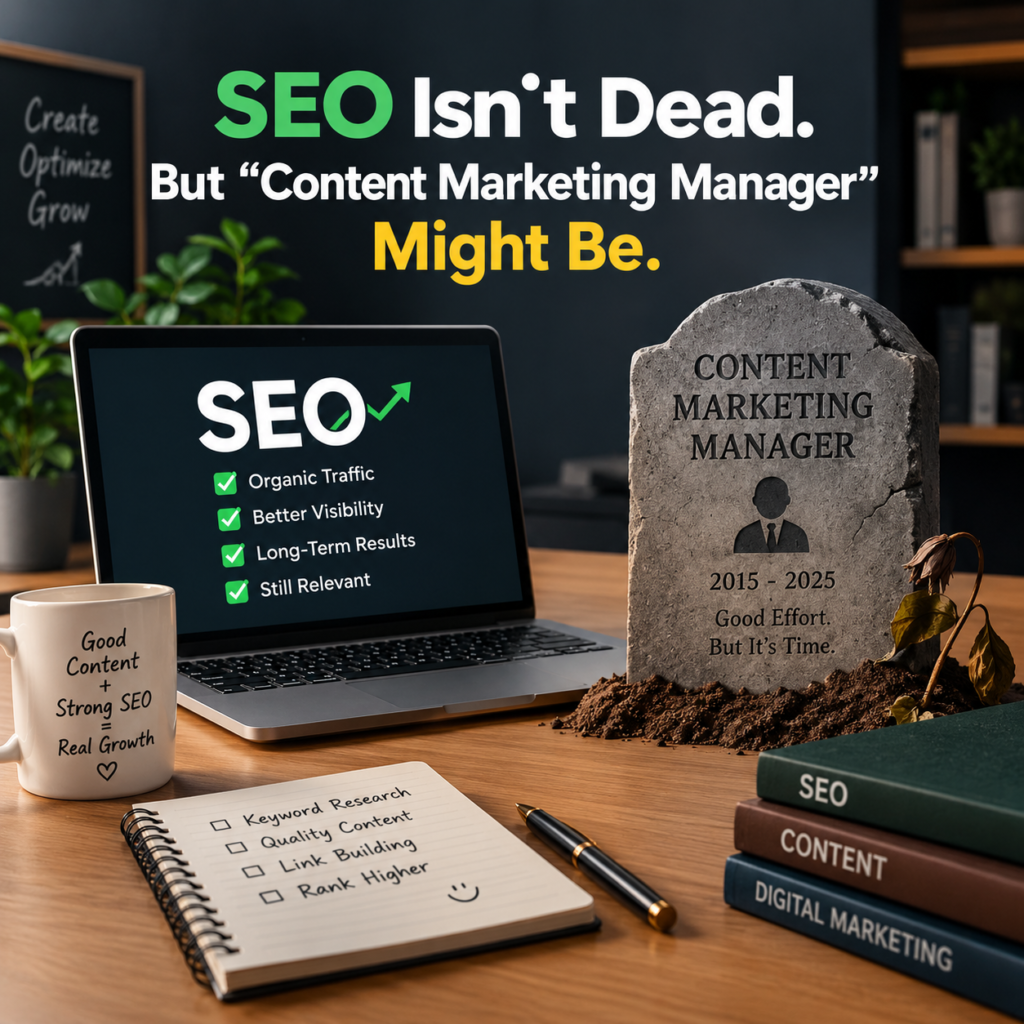
SEO Isn't Dead. But "Content Marketing Manager" Might Be.
Here’s a contradiction nobody in marketing wants to sit with: organic and AI-assisted discovery still bring in more qualified traffic, at lower cost, than paid channels for most businesses. And “Content Marketing Manager” is one of the fastest-shrinking job titles in marketing hiring data. Both are true at once. Pretend one cancels the other out, and you end up with either a bad career plan or a broken channel strategy.
Back in 2022, this debate ran on simple vocabulary: SEO vs. content marketing vs. social. That vocabulary is already stale. What’s happening now goes by names that barely existed three years ago — Answer Engine Optimization (AEO), Generative Engine Optimization (GEO). These aren’t rebrands. They describe something genuinely different about how discovery works in 2026.
The channel isn’t dead. The job description, as it was written, probably is.
What the Job Used to Be (2015–2023)
For about eight years, “Content Marketing Manager” meant a predictable loop: keyword tool, brief, freelancer, CMS, watch traffic climb. Underneath it was arbitrage — ranking organically was cheap compared to buying the same traffic through ads, and the gap was wide enough to justify whole teams built around volume. Publish enough decent content on the right terms and you could own a traffic line that would’ve cost six figures a month in paid search. That arbitrage held up long enough to make content marketing feel like a durable function instead of what it actually was — a moment in time.
What Closed the Gap
A few things happened at once.
Production got cheap. By 2025, most marketing teams were using AI tools to draft content, and the cost of a keyword-targeted article dropped toward zero for anyone with a decent writing tool. When cost collapses for everyone simultaneously, the volume advantage disappears — if you could out-publish rivals before, they can now out-publish you right back.
Clicks stopped being guaranteed. A large share of searches now resolve without anyone clicking through at all, and for informational, how-to queries, that’s often the majority. Ranking #1 doesn’t mean what it meant in 2021 if most people get their answer from an AI Overview and never leave the page.
Google started enforcing against the old playbook. Since the 2024 core updates targeting scaled and site-reputation content abuse, there are documented cases of sites losing 50–90% of rankings overnight, with some parasite-SEO pages de-indexed entirely. Recovery, if it happens, takes months or years.
And the hiring numbers agree. “Content Marketing Manager” postings peaked around 2022 and have been sliding since — not because companies stopped caring about content, but because what they need from it changed enough that the old title stopped fitting.
(Worth double-checking these specific stats against current data before publishing — directionally right, but should be sourced properly.)
SEO Got Harder, Not Smaller
Search didn’t shrink. It multiplied. The mistake in every “SEO is dead” take is treating Google’s blue links as the only surface that matters. The real discovery surface in 2026 spans Google organic and AI Overviews, ChatGPT, Perplexity, Bing/Copilot, TikTok and YouTube search, Reddit, LinkedIn, podcast search — all at once.
The win condition used to be rank and get the click. Now it’s get cited — be the source an AI answer pulls from, the Reddit thread that surfaces for “real experience,” the explainer Perplexity drops straight into a result.
Based on what we know so far about AI citation behavior, three things seem to matter most: originality (data or expertise that isn’t phrased identically on ten other sites), structured clarity (organized so a model can pull out an answer without guessing), and corroboration (mentioned elsewhere, not just linked to).
AEO/GEO is really the discipline of hitting those three marks across every surface, not just Google’s crawler. That’s a different skill from keyword-brief-publish.
The Job Split Into Five
What used to be one role is splitting into several, visible now in real hiring data:
Search & AI Visibility Strategist — thinks across Google, Perplexity, and ChatGPT together. “AI Search Strategist” is starting to show up as an actual title.
Subject Matter Editor — pulls real expertise out of people’s heads and turns it into something publishable. More editorial than marketing.
Distribution & Syndication Specialist — earns mentions on Reddit, in press, in industry pubs. Basically digital PR under a new name.
Content Operations Manager — runs the AI-assisted production pipeline and keeps structured data clean. Production, not strategy.
Search Performance Analyst — tracks AI citation share and brand mentions instead of traffic and sessions.
If you’re holding the old title, the honest question is: which of these five are you actually good at?
The Fair Pushback
“Our organic traffic is still growing.” Could be true for now — transactional and long-tail queries still convert reasonably well, and some industries haven’t saturated their content yet. Use the window. Just don’t plan five years around it staying open.
“Small niche sites can still compete.” More true than a few years ago. Sites with real, documented expertise hold up better than generic ones, partly because corroboration requirements now protect specialists instead of punishing them.
“Isn’t AEO just SEO with new jargon?” Fair question. The goal — being found — hasn’t changed. But the mechanics have diverged enough to matter: old SEO optimized for crawler ranking signals; AEO/GEO optimizes for how a generative system decides what to surface. Treat them as identical and you’ll fall behind without noticing why.
So What Do You Actually Do
If this is your job right now: get genuinely fluent in AEO/GEO, not just the vocabulary. Track AI citations and brand mentions, not just clicks. Build real editorial judgment — the ability to spot what’s actually original in your organization’s knowledge — because that outlasts any single platform.
If you’re hiring: resist hiring one generalist to cover all five unbundled jobs. Figure out which problem you actually have — visibility, differentiation, distribution, or production — and hire for that one specifically.
If you’re a founder deciding where content dollars go: publishing generic content at volume is a losing bet now. Original research and real presence across search, Reddit, YouTube, and AI answers is the better one — budgeted as a long game, not a six-week sprint.
Where That Leaves Us
The channel outlived the job, and that’s not a bad outcome. Search and discovery matter more to most businesses today than in 2015 — more surfaces, more audience, more chances to be useful at the exact moment someone needs an answer.
What didn’t survive was the specific workflow the old title was built around, because the arbitrage underneath it closed. What’s replacing it is harder and demands more real expertise. For anyone serious about the work, that’s not a loss.
The channel’s alive. Go figure out what your version of it looks like in 2026.